Total Pageviews

Showing posts with label Nanjing. Show all posts

Thursday, July 7, 2011

2 Days' Yangzhou Tour

If we could have more days, we would better enjoy ourselves in Yangzhou, while we can only spend our weekends here, so there are still some scenic spots we didn't touch upon. There are quite a lot famous tourist attractions in Yangzhou, including Slender West Lake, Da Ming temple, Flat Hills (Ping Shan) Hall, Pavilion of Flourishing Culture, Stone Pagoda, Tomb of Puhaddin, Ge Garden, He Garden, Yechun Garden, Yangzhou Museum & Yangzhou Block Printing Museum, Jiangdu Hydro Project, Yangzhou's three knives. Due to our limited time, we choose three most famous ones: Slender West Lake, He Garden and Ge Garden.

Yangzhou is a prefecture-level city in central Jiangsu Province, People's Republic of China. Sitting on the northern bank of the Yangtze River, it borders the provincial capital of Nanjing to the southwest, 318 km away from Suzhou and 589 km away from Hangzhou, transportation to these cities is quite convenient.

Compared to some bold cities in North China, like Beijing, Tianjin, Yangzhou is more a gentle girl, not occupying quite a large area, but it is clean, moist, warm and fine all the year round. Yangzhou architecture preserves traditional Jiangnan style: built in white wall and black roof, somewhat similar to the gardens in Suzhou and Hangzhou.

We arrived Yangzhou the Friday night, we have dinner at a small restaurant, by the way, Huaiyang cuisine is somewhat different from other 7 major Chinese cuisines. It applies more vinegar, and taste a little bit sweeter and almost never spicy, different from Sichuan or Hunan food, and also bearing less "brash" eating styles of northern China.

After dinner, we went to 1912, a street of bars, the sign of "1912" is interesting and particular. We stood on the plaza to enjoy the open-door performance rather entering any bars. The lights around the Jing-Hang Canal is also beautiful. He Garden is situated not far from "1912", we planned to go there the next morning, and Ge Garden the next after, the Slender West Lake is much bigger, so the day after the next day was left to the lake.

He Garden, I didn't clear up these photos immediately, so I don't know whether I remember correctly, I indefinitely recognize it is the front yard of He Garden
He Garden was built by He Zhidao, a Qing government official in the  19th century. He Garden is famous for a 430 m. (1,377 ft) two storied winding corridor, the walls of which are lined with stone tablets carved with lines of classical poetry, In the garden is also an open air theater set on an island in the middle of a fish pond.
one of the rooms in the garden, though it was still under the reign of the Qing government, it can be clearly found that western culture has already permeated in this house, the bed, the curtain, and the table near the window are all not in the traditional Chinese style.

our journey make you so happy?

Ge Garden: actually, it is a high rockery, while due to my poor skills in photography, it is not so obvious to notice its height.

finally, we arrived at the Slendar West Lake,though it is much smaller than the West Lake in Hangzhou, it preserves its own peculiarities. To see those colourful boats through dense willow leaves is interesting.
Hiring a boat and tour around the lake is certainly a good idea, but we are in a group of more than 20 members, and we want to see the beautiful scenery together, there is no boat can take all of us in, so we decided to visit the lake on foot.

sweeping willows are too common here, esp, around the lake

White Pagoda and Lotus Flower Pagoda
Guess what it is? It is the roof of the Lotus Flower, red-crowned crane is a symbol of longevity in China

Only when we stand at the foot of the pagoda, can we truely find how high it is. According to a guard standing nearby,  the tower is a little bit leaning, but we cannot see by our naked eyes

"24 bridge", it is famous for its appearance in Du Mu's poem(Du Mu, a famous Chinese poet in the Tang Dynasty). But it remains a mystery that whether it is the name of only one bridge or a collection name of 24 bridges as the original bridge(s) is already damaged.
Mao Zedong's calligraphy of Tang dynasty poet Du Mu poem


have a rest among so many beautiful and verdant flowers is so enjoyable 

where is the road heading for? so unwillingly to leave

Thursday, June 30, 2011

Choice Tours of Revolutionary Sites in China

With the approaching of CPC Founding Day, July 1, tour of revolution again attracted lots of tourists. To visit some revolutionary heritage will both enhance your understanding of China, geeting more fun in your China tour and get more real information of Chinese people's daily life, while at the same time, to feast your ears with fevered songs about revolution. Here are choiced tour pathes of revolutionary heritage.

1.Beijing-Zunhua-Leting-Tianjin
Main scenic spots are: Beijing Tian'anmen Square, Memorial Hall of Chinese War in Resistance Against Japan, Lugou Bridge, Wanping City, New Culture Movement Memorial Museum, The National Museum of China, Military Museum of the Chinese People`s Revolution , Memorial Hall of Beiping-Tianjin War, Li Dazhao's former residence and memorial hall in Leting, Tangshan, Memorial Hall of Zhou Enlai and Deng Yinchao in Tianjin, Cemetery of Revolutionary Matyrs-Li Dazhao, Panshan cemetery of revolutionary matyrs.

Lugou Bridge, which is famous for the stone lions on the bridge

Memorial Hall of Beiping-Tianjin War
2.Beijing-Baoding-Xibaipo
Main scenic spots are: Beijing Tian'anmen Square, Memorial Hall of Chinese War in Resistance Against Japan, Lugou Bridge, Wanping City, New Culture Movement Memorial Museum, The National Museum of China, memorial hall of tunnel warfare heritage in Jiaozhuang, Shunyi District, the original sites of Jin-Cha-Ji Border Region Government and the Military District Command, Tower of Five Heroes On Langya Mountain, Yi County, Baiyandian Scenic Spots in Anxin County, Ranzhuang tunnel warfare heritage in Qingyuan County, Memorial Hall of Bethune in Tang County, Xibaipo Memorial Hall in Pingshan, Shijiazhuang, Original Sites of the Central Committee of the Communist Party.

waxen images in Xibaipo Memorial Hall
3.Shanghai-Jiaxing-Pingyang
Main scenic spots are: the site of the first National Congress of the Communist Party of China, Longhua Cemetery of Revolutionary Martyrs, Song Qingling cemetery, former residence of Chen Yun, namely, the memorial hall of Qingpu Revolution; Nanhu scenic spot in Jiaxing (the old site of the Site of the First National Congress of the CPC), Zhenan Pingyang anti-Japanese base areas in Wenzhou.
 the site of the first National Congress of the Communist Party of China

4.Nanjing-Jiaxing-Pingyang
Main scenic spots are: Memoial Hall in Meiyuanxincun, Nanjing, cemetery of revolutionary matyrs in Yuhuatai, the memorial hall of the victims in Nanjing massacre by Japanese invaders, Memorial Hall of the victory in the battle across the river, Shajiabang Scenic Spots in Changshu, Memorial hall of Huangqiao Battle in Taixing, Taizhou, memorial hall of the refounding of New Fourth Army in Yancheng, Former residence of Zhou Enlai and memorial hall of Zhou Enlai in Huai'an; Old site of New Fourth Army headquarters in Huanghuatang; Memorial hall of Huaihai War in Xuzhou.
Nanjing Yuhuatai

 the memorial hall of the victims in Nanjing massacre by Japanese invaders

5.Nanchang-Ji'an-Jinggangshan
Main scenic spots are: Bayi revolt monument in Nanchang, memorial hall of Fang Zhimin, origial site of the Soviet government in Jian, Sites of the revolution in Ciping, Jinggangshan, Huangyangjie, cemetery of revolutionary matyrs in Jinggangshan.
Bayi revolt monument in Nanchang

6.Shaoshan-Ningxiang-Pingjiang
Main scenic spots are: former residence memorial hall of Mao Zedong in Shaoshan, Xiangtan; former residence and memorial hall of Peng Dehuai in Xiangtan Couty, former residence and memorial hall of Liu Shaoqi in Ningxiang Couty, Changsha; former residence and memorial hall of Yang Kaihui; Site of the Pingjiang Uprising, Yueyang city.
Ancenstral hall of the Mao

7.Guiyang-Zunyi-Renhuai-Chishui-Luzhou
Main scenic spots are: Memorial hall of Xifeng concentration camp, Guiyang, Wujiang scenic spots in Xifeng; sites of Zuiyi conference, Zunyi; Hongjunshan cemetery of revolutionary matyrs in Honghuagang district; memorial place of the Red Army fourth times crossing Chishui in Renhuai; sites of Huangbeijian war in Xishui County; cemetery of revolutionary matyrs of the Red Army in Chishui.
sites of Zuiyi conference

Tuesday, June 14, 2011

Beijing-Shanghai Express Railway Introduction

With the operation of Beijing-Shanghai Express Railway, the mysterious veil finally be uncovered, as I've mentioned yesterday that the designed speed is 380 km/h, and from Beijing to Shanghai can be shortened to as much as 4 hours and 48 minutes. Now I will say more information of the railway.
All along the way, it will pass totally 23 stations, namely Bejing south station, Langfang station, Tianjin west station, Cangzhou west station, Dezhou east station, Jinan west station, Taian station, Qufu east station, Tengzhou east station, Zaozhuang station, Xuzhou east station, Suzhou east station, Bengbu south station, Dingyuan station, Chuzhou station, Nanjing south station, Zhenjiang south station,Danyang north station, Changzhou north station, Wuxi east station, Suzhou north station, Kunshan south station and Shanghai Hongqiao station, passing through 6 provinces and regions.
On the way, you can appreciate the various scene changing from North China to South China, and it is good time to enjoy except for Beijing and Shanghai, you can also see Confucius Temple, Mt. Tai, Mt. Yimeng in Shandong Province.
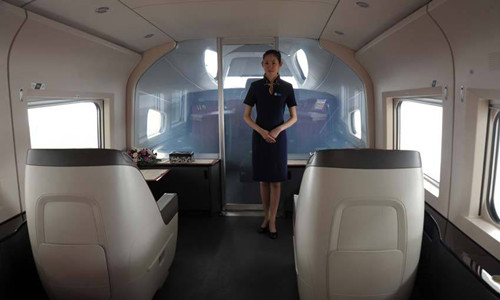
Though the ticket price is much higher than normal railways, the equipment is of higher level. It is classified into business class, first class, second class cabin as well as a dinning cabin.
In business class cabin, you can modify the chair freely since you enjoy large enough room, and TV is equiped which can also surf the Internet. In the first class and second class cabin, though there is no TV, you can listen to the radio. Different from traditional Chinese trains, there provided socket for charging. More vivid image can be found on the vedio above, and detailed information can be found at Onlinechinatours.

Chairs, see the blue button on the right side of the handril, by pressing these buttons, you can modify the gesture of your chair 

steward in the train, it is said they are well-trained, not only familiar with their responsibilities of offering service on the train, but also know much about the scenic spots outside of the window. So when take the train, you can have a free tour guide.

TV, it can also used to surf the internet. See the small desk? It can be used as a desk for reading and eating, it can also be folded to save space. On one side of the chair, there is also a light, which can be used in the night for reading or doing something else.

Dinning cabin

Monday, May 30, 2011

Tour during the Dragon Boat Festival

As it is forcasted by the weather forecast that it is likely to rain around the Dragon Boat Festival in the south China regions, including Guangxi, Hunan and Hubei Province, so if you are planning to experience a typical Chinese Dragon Boat Festival in sunny days, you may choose among these areas: Xiamen, Nanjing, Wuzhen, Zhouzhuang, well, of course, Beijing is also a good choice never out of date, where you can appreciate the profound culture relics, like Summer Palace, the Great Wall, the Imperial Palace, and as well the modern architecture, the most well-known representative ones are the Birds Nest and the Water Cube. Further information can be found on onlinechinatours.

Qinhuai River, Nanjing, where leaves masses of Chinese poems and love stories


Qinhuai River in the night

Zhongshan Mausoleum, Nanjing

Wuzhen, Zhejiang Province

Wuzhen, still keeps the features of its origial color

Zhouzhuang, Jiangsu Province

Zhouzhuang

Zhouzhuang

Xiamen, Guangdong Province

Xiamen

Tian'anmen Square, Beijing

the well-known Birds Nest, the main stadium of the 2008 Beijing Olmpic Games

Water Cube and the Bird's Nest in the night